
There are words that appear in the menu of a restaurant and generate a pause. Nikkei is one of them. It’s not an ingredient, it’s not a technique, it’s not a dish name—and yet it explains everything. Whoever sees it for the first time intuits that there is something behind it that is worth understanding before asking blindly. This article is written precisely for that: so that the next time the term appears you know exactly What does it mean, where it comes from and why it has gained respect for world cuisine.
What is Nikkei: a clear definition before continuing
Nikkei cuisine is the fusion between Japanese culinary tradition and Peruvian cuisine. It is not a free mix of Asian techniques with Latin American ingredients, nor a reinterpretation of author with nods to two cultures. It is a gastronomic category with its own identity, documented history and defined technique, recognized today in the most demanding guides in the world, including the Michelin.
when someone asks what is nikkei or What is Nikkei cuisine, the most honest answer is not a description of dishes, but of a process: two kitchens with a very different base —one marked by precision, cut and fermentation; the other for spicy, citrus and product diversity—which were found in a specific place and at a time, and that for decades they developed a common language without either losing their accent.
That is exactly what distinguishes Nikkei from generic fusion: there was no chef who decided to mix them. There were people who lived between the two.
Where does the word nikkei come from and why does it matter?
Nikkei It is not a gastronomic term at origin. In Japanese he designates Japanese emigrants and their descendants born out of Japan. The word combines the characters of Nichi (Japan) and Kei (lineage, offspring). It is, above all, a term of cultural identity.
Understanding that changes the way you read the kitchen that bears your name. Nikkei food is not a creative proposal that someone designed in a test kitchen: it is the result of what generations of people who were Japanese by training and Peruvians for daily life cooked at home. The name came later, when the gastronomic world needed a label for something that had already existed for decades.
The historical origin: Japanese immigrants in Peru of the 19th century
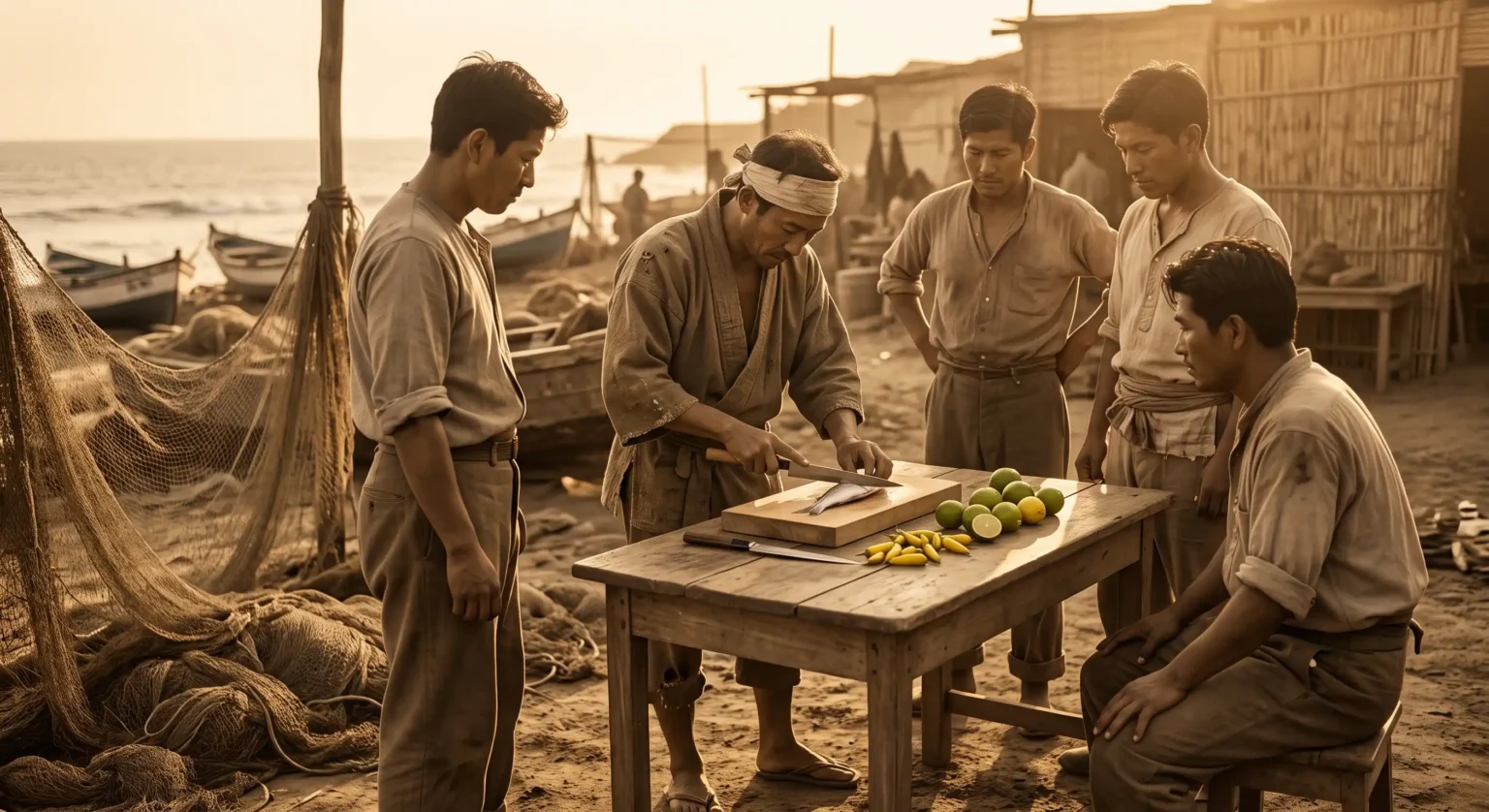
The starting point is 1899. That year the first Japanese workers hired for the sugar and cotton farms on the coast arrive in Peru. They are not cooks, they are not gastronomers: They are braceros who bring with them the only heritage that no one can take away from them, which is the memory of how they cook at home.
The problem —and the germ of everything that comes after—is that In Peru they do not find the ingredients of that memory. There is no easy dashi, there is not the same fish, there are no algae or fermented sauces they are used to. What there is is an extraordinary product: fresh Pacific fish, yellow chili, lime, purple corn, cassava. and a Peruvian culinary culture with centuries of its own sophistication.
The adaptation was not a creative exercise. It was a necessity. But the need, when held for decades and passed down from generation to generation, generates something that no tasting menu can simulate: real kitchen. Throughout the 20th century, the descendants of those first emigrants — the Peruvian Nikkei — unpretentiously built a kitchen that spoke the two languages fluently.
Key Techniques and Ingredients of Nikkei Cuisine
Nikkei’s technical vocabulary is built on the crossing of two very precise cooking logics. Some of its most recognizable signs:
The Sashimi-style cut Applied to Peruvian Pacific fish —corvina, sole, yellowfin tuna— that gives rise to the tiradito, brother of the ceviche but without onion, with clean sheets and a sauce that combines tiger milk with hints of soy or miso. The Japanese influence is not in the ornament: it is in how the product is touched.
The soy and miso as replacements or complements of salt and acid in elaborations that in Peru would be purely citrus. The result is marinated with a umami depth—you can read more about what is umami And why it transforms the flavor of any dish—that classic ceviche doesn’t look for.
The wok with yellow chili, Dry and high temperature heat transfer of Chinese-Japanese cuisine applied to Peruvian native ingredients. The result is a texture that neither of the two separate kitchens would produce.
The Rice with Japanese technique —Cooked with precision, sometimes vinegary— as a base of rolls that incorporate Peruvian ingredients: chili, olive, causa, crayfish.
nikkei dishes you have to know
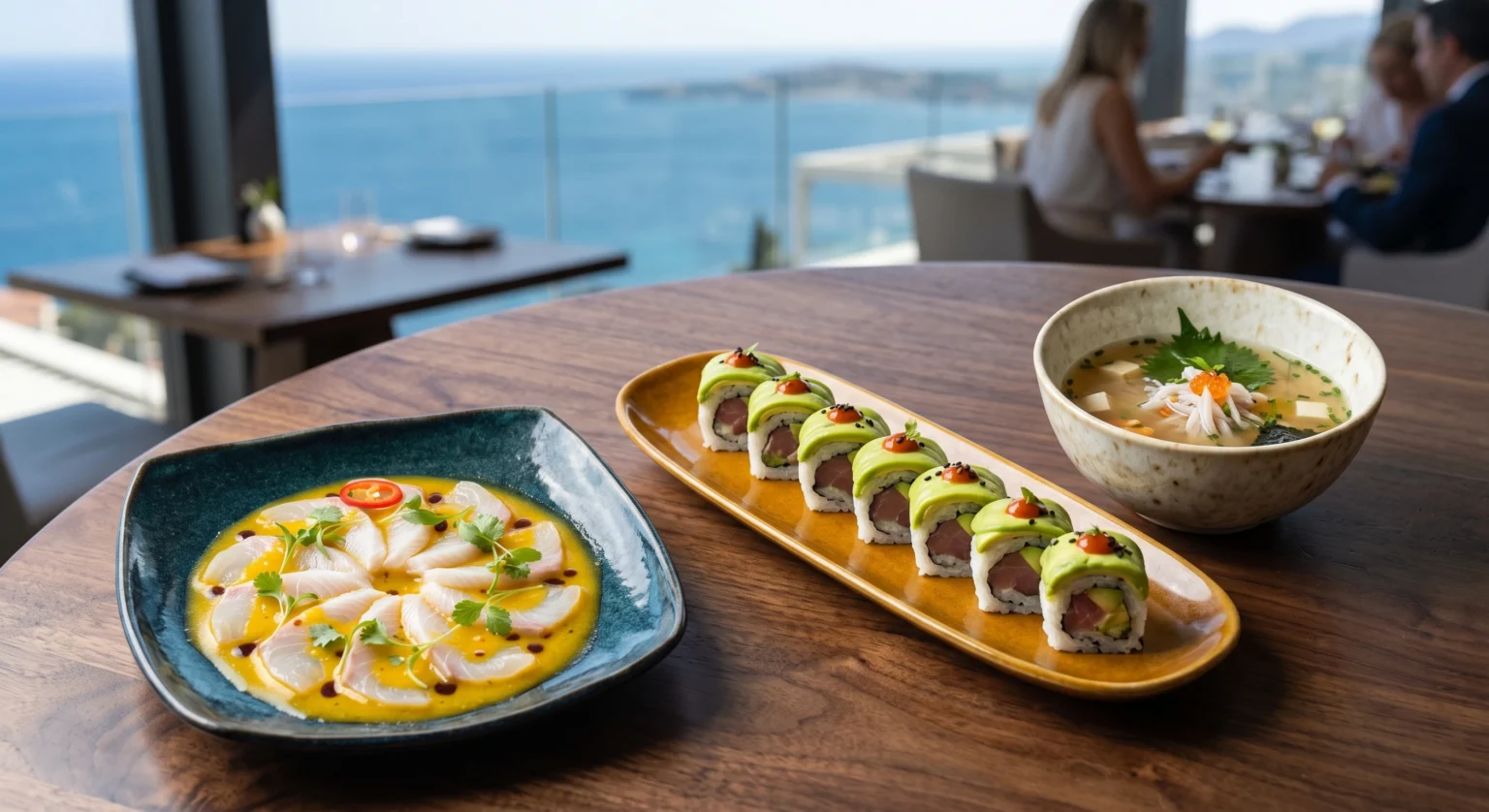
The Tiradito It is the most representative dish and the one that best illustrates what Nikkei food is for those who have never tasted it. Visually it resembles sashimi — thin sheets of raw fish arranged with cleanliness — but the dressing is unequivocally Peruvian: tiger milk, yellow chili, sometimes rocoto. The fusion is not declared, it is on the plate.
the sneaky rolls They are the most popular translation: maki or uramaki stuffed and crowned with preparations that instead of Japanese mayonnaise carry tiger milk, chili or even guacamole. They are the most accessible entrance to the Nikkei universe for those who come from sushi.
The Nikkei Cause Reformulate the Lima cause —that cold yellow potato cake with chili—with fillings that incorporate Japanese technique: tuna tartare with soybeans, crab with mild wasabi, salmon with avocado cream and ginger.
Nikkei rice or Chaufa Nikkei, derived from Peruvian-Chinese chaufa rice but reinterpreted with Japanese ingredients, is perhaps the most everyday and least glamorous dish, and precisely for this reason the most honest one: it talks about what was eaten at home, not in restaurants with printed menu.
What distinguishes serious fusion from decorative fusion
If the Nikkei serves for something beyond the gastronomic experience, it is to develop criteria. The question that any diner with a culinary culture ends up asking before a merger letter is always the same: Does this make real sense or is it just a buzzword to justify a menu without identity?
The history of the Nikkei offers a practical answer. A serious fusion has two conditions: that the two traditions that intersect are real, with their own technique and product, and that the crossing has had enough time to generate something new that neither of them could produce alone. When these two conditions are met, the result does not need an explanation in the letter — it shows on the plate.
When they are not fulfilled, the fusion is decorative: two aesthetics mixed to look interesting, without the depth that only the real knowledge of both traditions gives.
Nikkei is proof that the first option exists. And that forces us to demand it.
The Asian-Mediterranean Fusion of Katagi Blau: Another Tradition, The Same Logic
Katagi Blau does not serve Nikkei cuisine. It is convenient to say it bluntly, because honesty is part of the criterion that this article defends. What the restaurant proposes from its rooftop in Playa de Palma is an Asian-Mediterranean fusion: the meeting between the technique and the aesthetics of Asian cuisine and the Mediterranean product, with Mallorca as a stage and the sea as a common thread.
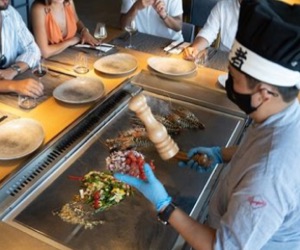
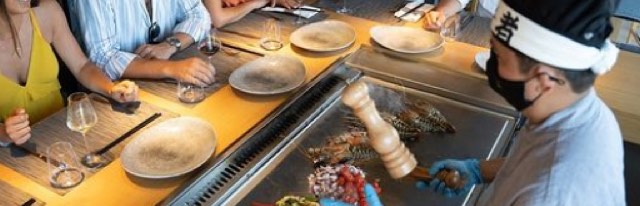
The logic, however, is the same one that holds the Nikkei. It’s not about mixing two cards to look original. It is about really knowing the two traditions that are put into dialogue —their techniques, its products, its times— and letting them speak from that knowledge. The teppanyaki That chef Jose Pellegrino executes in Katagi Blau is not Japanese with Mediterranean touches, nor Mediterranean with Asian presentation: It is a proposal where both logics are present with rigor, exactly like the tiradito is not sushi with lime but something that neither of the two kitchens would have produced separately.
Whoever understands the Nikkei understands why that matters. And whoever wants to check it has the Teppanyaki Show Cooking, the Brunch and the letter to the letter as a starting point.
As you will see, the Nikkei is not an Instagram trend or the whim of a chef with a desire to innovate. It is one of the most respected culinary fusions in the world precisely because it was born without wanting to be: Of people who cooked what they knew with what they had, for generations, until the result was so solid that the gastronomic world had no choice but to recognize it. That is your authority. And that is also the lesson it leaves for any diner with criteria: the fusion that is worth not announced is shown on the plate.