
There are flavors that you recognize before you can name them. That broth that makes you close your eyes for a second. The piece of cured cheese that you cannot stop eating even if you are already full. The anchovy on a pizza that transforms everything else. None of those moments has to do only with the salty, the acid or the sweet. It has to do with something deeper, more persistent, more difficult to describe. It has to do with umami.
This article exists so that you can name something you already know, and so that you understand why that name changes the way of reading a menu, of cooking at home and of understanding why certain kitchens in the world work so well together.
What is umami: the fifth flavor you have always felt without knowing how to name it
For centuries, Western gastronomy described flavor in four categories: sweet, salty, acid and bitter. A useful model, but incomplete. Because There was a feeling that did not fit into any of those boxes and that, however, was present in the most satisfying dishes of almost all the cultures of the world.
Umami is the fifth basic flavor. It is not a gastronomic trend or an author restaurant fashion. It is a category as real and physiologically recognized as sweet or salty, which responds to specific receptors in the language and produces a different response to any of the other four flavors.
What makes umami special is not its intensity but its behavior: it does not arrive, it hits and leaves. It is installed. It spreads through the mouth, fills it in a way that is difficult to articulate, and makes you want to continue eating. If you have ever said that a dish “had something” without being able to specify what, it is most likely that something was umami.
What does umami mean: the origin of a word that explains everything
The word umami (旨味) comes from Japanese and translates roughly as “tasty flavor” or “delicious flavor”. That translation, no matter how obvious it may seem, already contains the key to everything: it does not describe a specific quality —sweetness, acidity, bitterness— but a global experience of taste satisfaction.
While the other four basic flavors describe objective chemical properties, The umami describes what that property does to the palate. It’s almost more a feeling than a taste, which explains why so many people have felt it all their lives without having a name for it.
That this word came from Japanese is no coincidence. Japanese cuisine has been built on ingredients that contain it in a concentrated way, and her culinary culture developed a sensitivity to that depth of flavor long before science formalized her.
How did you discover the science that umami is a real taste?
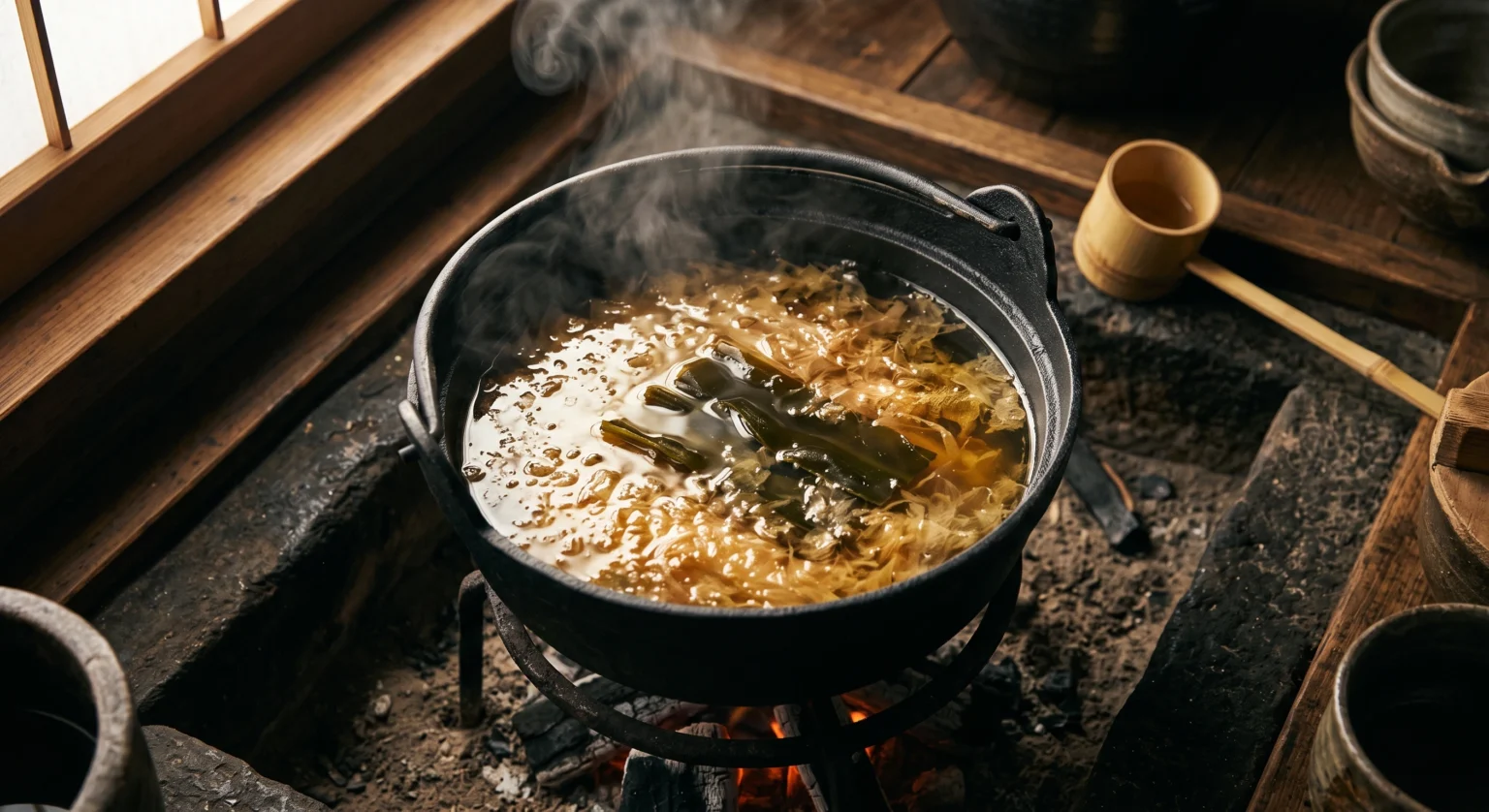
In 1908, the Japanese chemist Kikunae Ikeda was eating dashi soup—a kombu-based broth—when he noticed something he couldn’t explain with the four known flavors. There was a depth in that broth that was not sweet, it was not salty, it was neither acidic nor bitter. So he investigated it.
What he found was glutamic acid, or glutamate, the compound responsible for that feeling. He isolated him, named him and called him Umami. Science took almost a century to confirm it definitively—the specific receptors for glutamate in the human language were not identified until the 2000s—but what Ikeda had described was real.
The curious thing is that science did not teach anything new to chefs. He gave them a name for something they already did intuitively. The French fond, the Japanese miso, the slow Mediterranean sofrito: they are all umami concentration techniques. The difference is that we now know why they work.
What exactly does the umami taste like: what happens in the tongue when you perceive it
Describing umami with precision is one of the most interesting exercises in gastronomy, precisely because it does not fit the usual adjectives.. It’s not “strong”. It is not “salty with more intensity”. It’s not “spicy”. It’s something else.
What umami produces in the mouth is a combination of three simultaneous sensations: Depth (the perception that the taste has layers, which goes beyond the surface), persistence (remains on the palate long after swallowing, lengthening the pleasure of the bite) and salivation (Activate the production of saliva in a specific way that makes the mouth prepare to continue eating).
The result is what the Japanese call *kokumi*: a feeling of roundness, of fullness, that the plate is complete. If you’ve ever eaten something and felt like “something was missing” without knowing what, umami was probably missing. And if you’ve ever eaten something that didn’t seem specially elaborate but it was impossible to leave, it’s likely that you were before a concentrated source of it.
What foods do umami have: from Japan to the Mediterranean without leaving the pantry
Here begins the part that surprises many people: Umami is not an exotic ingredient to look for in a specialized store. It is in the pantry of almost any kitchen in the world.
In the Japanese tradition, the most concentrated sources are kombu seaweed, dry bonito flakes (katsuobushi), soy sauce, miso and shiitake mushrooms. The dashi—the base broth of Japanese cuisine—is essentially umami in a liquid state.
In the Mediterranean tradition, the sources are equally powerful, although less well known by that name: Concentrated or sun-ripened tomato, salted anchovy, cured cheese (especially Parmesan and long-ripened cheeses), olives, Iberian ham, wild mushrooms and quality olive oil.
Two kitchens that look like separate worlds share, without having agreed, the same principles of flavor construction. That coincidence is not an accident.
Why umami is the real reason that Asian-Mediterranean fusion works
This is the point at which most Umami articles fall short. They explain Ikeda’s discovery, list the ingredients, and there they leave it, as if the umami were an interesting Japanese curiosity and little else.
There is something that this approach ignores: the umami is not just a fascinating fact about Japanese cuisine. It is the technical principle that explains why two seemingly opposite culinary traditions — the Japanese and the Mediterranean — can be found on a plate without the result sounding like a forced mixture.
Dashi and soy arrive at the umami for the glutamate of the sea. Concentrated tomato, anchovy and cured cheese arrive at the same site by the soil glutamate. They are different paths towards the same gustatory backbone. And that means that when you combine ingredients from both traditions respecting that logic, you are not mixing two kitchens: you are acknowledging that they were never that far away.
In Katagi Blau, that’s not an aesthetic idea or a letter statement of intent. It is the technical principle from which the kitchen is built. The Asian-Mediterranean fusion works here because it doesn’t start from the question “What combination is pretty?” but of “what do these two traditions share at their root?”. The answer, almost always, goes through the umami.
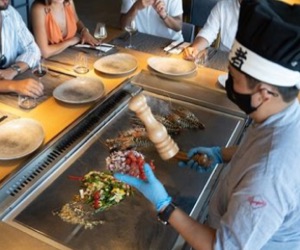
That also explains why teppanyaki—where the cook works live in front of the diner, without heavy sauces that mask the product—can hold that conversation with total honesty. When the taste comes out of the technique and the ingredient, and not from a shortcut, the umami becomes visible. If you are curious to see it in action, you can Book an experience in teppanyaki And check it first hand.
Umami in the kitchen: how to use it to cook with more flavor and less salt
Understanding umami has an immediate practical consequence: you can cook with more flavor using less salt, less sugar and less fat as compensation. Not because the umami replaces them, but because it fills a gap that the kitchen without it tends to compensate with excess of the rest.
Some concrete ideas to take advantage of at home:
- Adding a strip of kombu to legume or rice cooking water does not give Japanese flavor to the dish: it gives depth.
- Concentrating the tomato in the pan before adding liquid to the sauce multiplies its power.
- Finishing a stew with some anchovies dissolved in the initial oil is one of the oldest techniques in Mediterranean cuisine, and it works exactly for this reason.
- Storing the Parmesan crust to incorporate it into broths and sauces is another.
Umami also enhances the perception of other flavors. A glutamate-rich broth makes the salty taste more salty, the sweeter is more appreciable, that the acidity is better integrated. It is, in that sense, the equalizer of a plate.
Umami and monosodium glutamate: the most frequent confusion resolved
When glutamate is mentioned in relation to umami, many people activate a reasonable suspicion: monosodium glutamate, the famous MSG, has been designated for decades as responsible for the so-called “Chinese restaurant syndrome”, a reaction of headache and discomfort that supposedly produced.
It is worth clarifying without technicalities: Monosodium glutamate is a form of synthetic glutamate that is added to foods as a flavor enhancer. Natural umami is the glutamate that is present inherently in foods —in tomatoes, in cheese, in soybeans— as a result of its composition or its maturation and fermentation process.
The suspicion towards the MSG has a complex history. Scientific studies have found no solid evidence that monosodium glutamate causes adverse effects at usual doses in the diet. And in any case, the umami that we talked about in this article —the one in Kombu, in anchovy, in miso, in Parmesan— is glutamate in its natural form, present in those foods without any addition process. The difference is the same that exists between the sugar of a ripe fruit and the refined sugar added to a soft drink.
Frequently Asked Questions about the UMAMI
What is umami exactly?
Umami is the fifth basic flavor, along with sweet, salty, acid and bitter. It is perceived thanks to specific receptors on the tongue that respond to glutamate, an amino acid present naturally in many foods. It is characterized by its depth, persistence and the feeling of fullness that it generates on the palate.
What does umami mean?
Umami is a Japanese word that translates as “tasty flavor” or “delicious flavor”. It was coined by the chemist Kikunae Ikeda in 1908 when he identified the compound responsible for that taste sensation in Kombu algae.
What is the taste of umami?
The umami does not have a taste of its own that you can easily isolate like sweet or acid. What it produces is a feeling of depth and roundness that amplifies and enriches the other flavors of the dish. It is more an effect on the set than an individual note.
What foods have umami flavor?
Among the best known: Kombu seaweed, soy sauce, miso, bonito flakes, shiitake mushrooms, ripe or concentrated tomato, salted anchovy, Parmesan cheese and other cured cheeses, olives and mushrooms.
Is umami the same as monosodium glutamate?
No. Umami is a category of flavor, produced by glutamate naturally present in foods. Monosodium glutamate is a synthetic additive that mimics that effect. The natural umami that appears in cheese, tomato or soy has nothing to do with industrial additives.
What is umami used for in the kitchen?
Umami serves to give depth and complete the flavor of a dish without having to add more salt, more fat or more sugar as compensation. It also has a synergistic effect: combining several sources of umami on the same plate multiplies the result beyond the sum of its parts.

The umami is not a new concept. It is something that you have tried all your life in your grandmother’s broth, in the cheese that you could not leave, in that dish that you did not know how to describe but that you ordered again. What has changed is that you now have a name for him, and with that name you also have a way to read the kitchen in another way.
Understanding the umami is understanding why certain kitchens in the world look more alike than they seem. Why dashi and sofrito share something essential. Why the fusion, when well thought out, is not a capricious mixture but the recognition of a common origin.
If this perspective whets your appetite to explore more, you can take a look at our article on What to eat in Mallorca to continue building criteria before sitting at the table. And if you are already on the island —or you will be soon—, the Restaurant menu It is the place where all this ceases to be theory.