
Wagyu is beef from four Japanese cattle breeds, of which Japanese Black (Kuroge) is by far the most widespread. The word literally means “Japanese cow” (wa, Japan; gyu, cow). What sets it apart is fat woven into the muscle, known as marbling, which melts at a lower temperature than the fat of other cattle. And it’s precisely because of that fat that the best wagyu isn’t eaten as a big steak.
When it appears on a menu, the word wagyu can stand for an exceptional product or simply be used as a hook. Knowing what lies behind it (the breed, the grade, the origin) is what lets you tell one from the other before you order.
What is wagyu beef? A breed, not a cut or a brand
Wagyu is not a cut of meat or a single protected designation. It’s the umbrella name for four Japanese cattle breeds selected over generations for their ability to build up fat between the muscle fibres. That intramuscular fat, the marbling, is what sets this beef apart from any other.
So what animal is wagyu? Simply a cow: Japanese-breed cattle whose genetics favour an extraordinary build-up of intramuscular fat. For centuries, cattle in Japan were mainly working animals on farms. Breeding for meat quality only began in the 20th century, and the four breeds were officially recognised in 1944. Since then, genetics, slow rearing and careful feeding have fixed and reinforced that marbling.
The four Japanese wagyu breeds
Four recognised breeds come under the name wagyu.
Japanese Black (Kuroge Washu) is the most widespread and produces practically all the A5 wagyu that reaches the international market. It’s the benchmark whenever people talk about extreme marbling.
Japanese Brown (Akage Washu), also known as akaushi or “red cow”, has less marbling, leaner meat and a more pronounced flavour.
Japanese Polled (Mukaku Washu), the hornless breed, is the rarest of the four, and its production is almost symbolic.
Japanese Shorthorn (Nihon Tankaku Washu) comes from northern Japan, is adapted to cold climates and is kept in very small numbers.
When a menu says “Japanese A5 wagyu” and nothing more, it’s almost always Japanese Black.
Why wagyu marbling is different
Marbling isn’t exclusive to wagyu, but its make-up is special. The intramuscular fat of Japanese wagyu is particularly rich in monounsaturated fatty acids, which is why it melts at a lower temperature than the fat of other cattle breeds. In practice, it melts within seconds on a hot plate and, in the most heavily marbled cuts, almost with the warmth of your hand.
That has a direct effect on flavour. Fat carries a large share of the meat’s aromatic compounds and makes the taste linger. Add to that the glutamate and nucleotides in the muscle, which are responsible for umami: that deep, lasting taste that is neither salty nor sweet, but a basic taste in its own right.
None of this makes wagyu a light meat. It’s still very fatty, and that’s exactly why it’s eaten in small amounts.
How Japanese grading works: what A5 and BMS mean
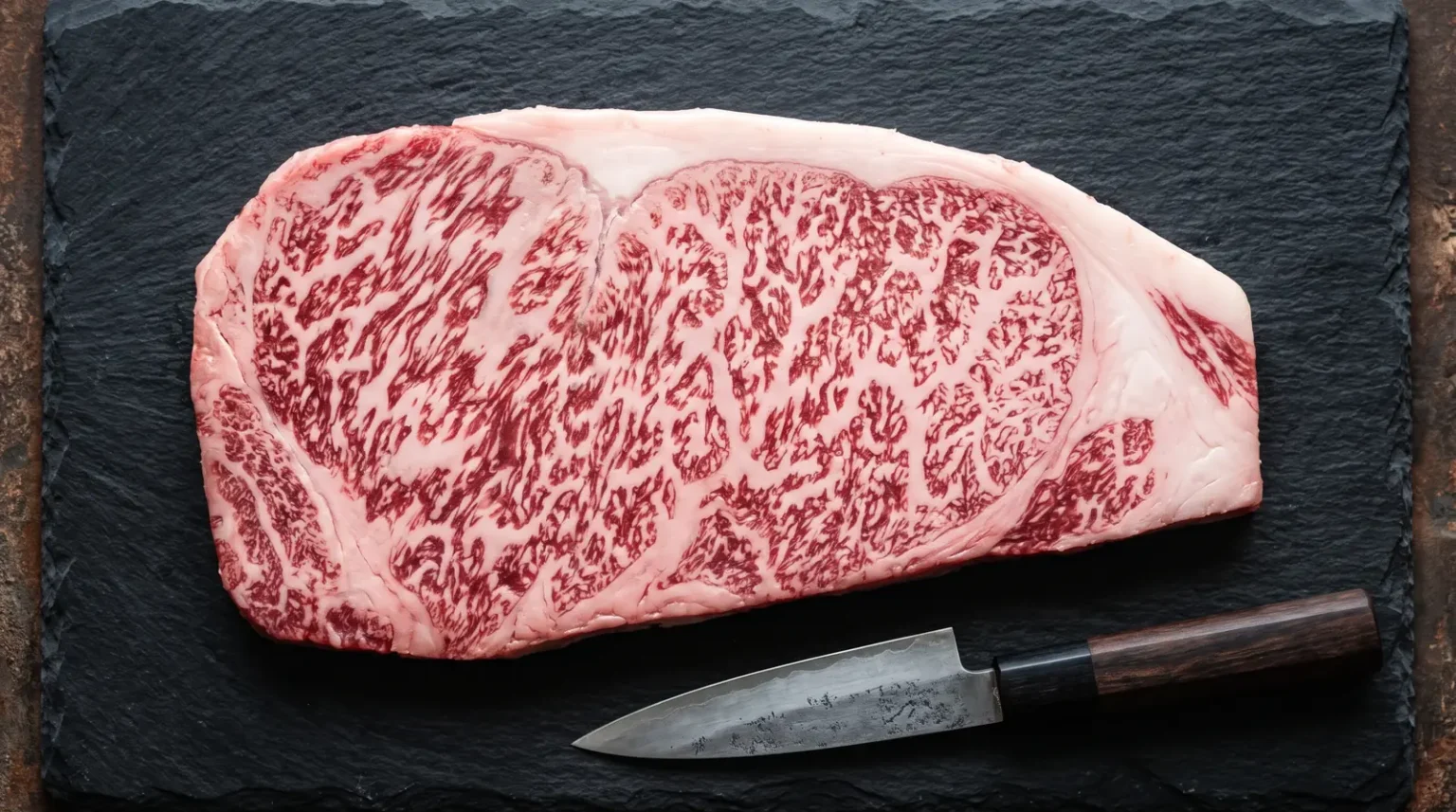
The Japanese grading system has two independent scales that are combined on the label, plus a scale of its own for marbling.
| Component | Scale | What it measures |
|---|---|---|
| Letter (A, B, C) | A is the highest | Yield: how much usable meat the carcass provides |
| Number (1 to 5) | 5 is the highest | Quality: marbling, colour, firmness and texture of the meat, and quality of the fat |
| BMS (1 to 12) | 12 is the highest | Degree of marbling, which counts towards the quality number |
A5 wagyu reaches the top level for both yield and quality, and to score a 5 it needs a BMS of 8 to 12. That’s why BMS 10 and BMS 12 can both be A5, even though the second has more marbling.
When a menu says “Japanese A5 wagyu”, it is stating the highest grade in Japan’s official grading system. That’s a verifiable fact, not an adjective.
Wagyu and Kobe beef are not the same thing
Kobe is a certified designation, not another word for wagyu. For meat to be called Kobe beef, the animal must be of the Tajima strain, a line of Japanese Black; it must have been born, raised and slaughtered in Hyōgo Prefecture; and it must meet the marbling and weight criteria set by the Kobe Beef Marketing & Distribution Promotion Association.
Put simply: all Kobe beef is wagyu, but the vast majority of wagyu is not Kobe.
Japan has other regional designations with an equally strong reputation, such as Matsusaka and Ōmi, which follow the same logic: breed, territory and certified production criteria. None of them is a synonym for wagyu in general.
Wagyu outside Japan: British, Australian and beyond
Australia, the United States, the UK, Germany and Spain all produce beef sold as wagyu. In most cases it comes from crossbreeds, often with Angus, that use Japanese genetics to improve marbling. In the UK you’ll find both British and Australian wagyu at butchers and on restaurant menus, and it’s worth checking whether a given one is full-blood or a cross. It’s good-quality beef, but the marbling of a crossbreed doesn’t reach that of Japanese A5 wagyu, either in density or in the make-up of the fat.
To read a menu with a critical eye, look for two things: whether it says “Japanese” and whether it gives the grade. Wagyu with no stated origin is usually a crossbreed. A menu that says “Japanese A5 wagyu” is giving you specific, verifiable information.
Why A5 wagyu is eaten in small bites, not as a big steak
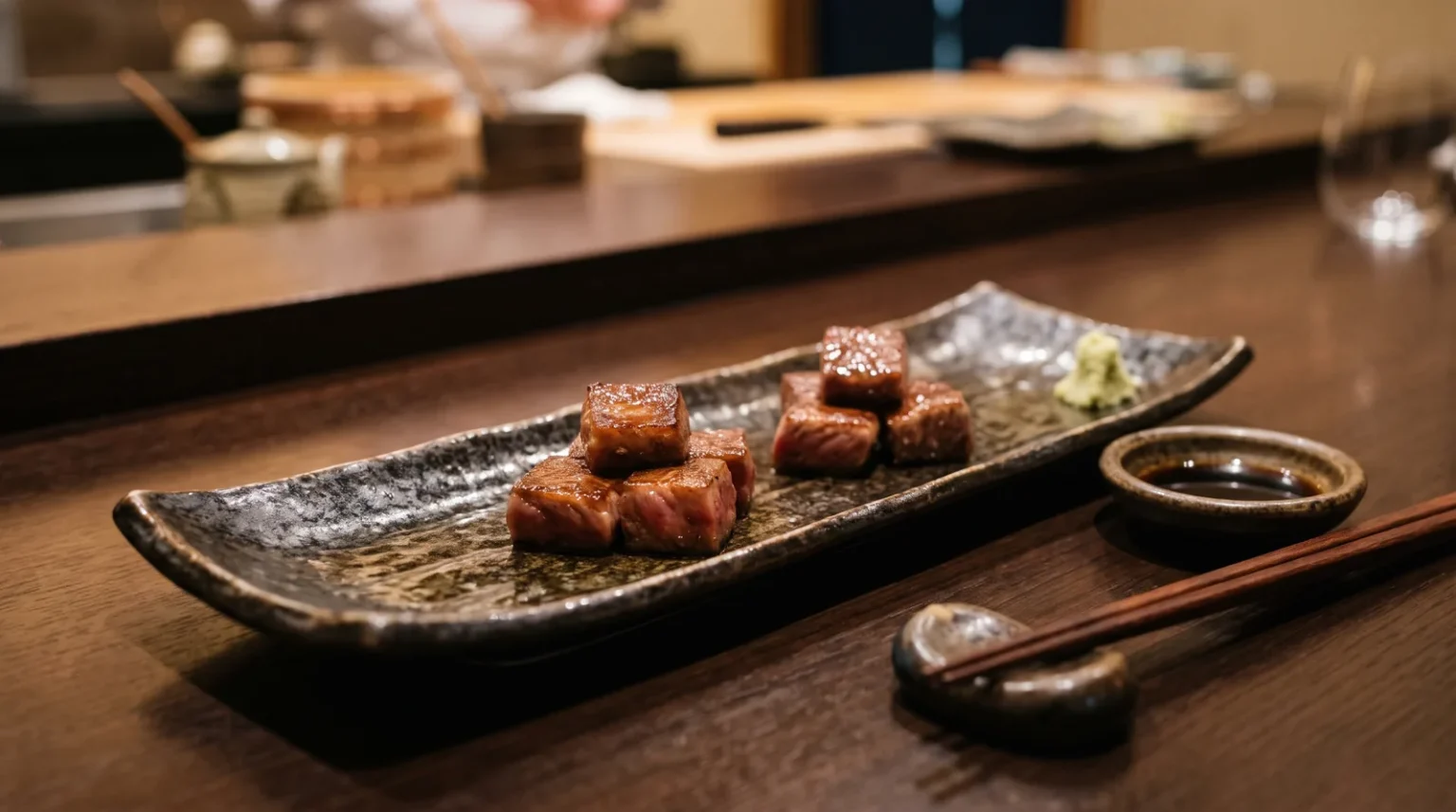
This is what hardly any shop explains when it sells large cuts of A5 wagyu: the fat content of this meat is so high that, after the first few bites, your palate is overwhelmed. That isn’t a flaw in the product; it’s its nature.
In Japan, wagyu is served in thin slices for shabu-shabu, swished for a few seconds through hot broth, or for sukiyaki; in small cubes seared on a hot plate; or as nigiri. The common denominator is always the same: high heat, very short cooking and a small portion. The heat melts the fat on the surface without overcooking the meat, and the small portion lets your palate take in all the intensity without it becoming cloying.
A half-kilo A5 steak is more showpiece than cooking. Not because the meat is bad, but because the format doesn’t respect what that fat needs. A5 wagyu fat can’t take prolonged heat: it responds in seconds and calls for a bite that’s over before it starts to feel heavy.
A5 wagyu aburi nigiri at Katagi Blau
At Katagi Blau, an Asian-Mediterranean fusion restaurant in Playa de Palma, wagyu appears in just one form: aburi nigiri of Japanese A5 wagyu with wagyu fat emulsion, served as two pieces.
Aburi is nigiri finished with a blowtorch. The heat melts the surface of the fat over the rice in two or three seconds. The fat doesn’t drip off or disappear: it turns translucent and glossy and binds with the rice. The bite is small, the heat has been brief and there’s nothing else covering the meat. It’s wagyu beef sushi at its simplest.
It’s the format that makes most sense for this meat, and it’s the one Katagi Blau serves. Two pieces are enough to understand what makes Japanese A5 wagyu different.
You’ll find our Japanese A5 wagyu nigiri in the Nigiri Aburi section of the menu.
Another route to flavour: older-cow beef on the teppanyaki
Wagyu’s flavour comes from its fat. The flavour of vaca vieja, as beef from older cows is known in Spain, comes from somewhere else: time. A cow that has lived several years longer develops harder-working muscle, with more myoglobin and more aromatic complexity, and dry-ageing then concentrates it further. The result is nothing like wagyu, but it reaches a comparable intensity of flavour from a completely different starting point.
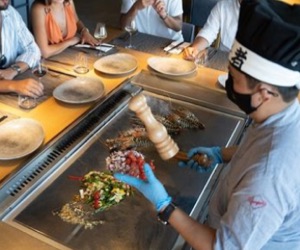
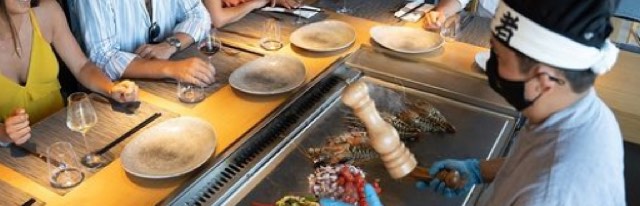
At Katagi Blau you’ll find both. Japanese A5 wagyu in the aburi nigiri. Older-cow beef in the Katagi steak on the menu and in the sirloin of the Teppan 2 menu at our teppanyaki in Palma, cooked on the hot plate right in front of you. The hot plate, which is what teppanyaki is all about, also delivers high, direct heat: different from the blowtorch in form, similar in result for a meat that doesn’t need sauces to cover it.
The fact that two such different meats call for similar heat says a lot about why Asian-Mediterranean fusion works when there’s real produce behind it.
Frequently asked questions about wagyu
Is wagyu healthier than other beef?
The fat in Japanese wagyu has a higher proportion of monounsaturated fatty acids than that of conventional beef. Even so, it’s still a very fatty meat, which is why it’s eaten in small amounts. Its appeal is gastronomic rather than nutritional.
Why is Japanese wagyu so expensive?
Several reasons add up. Rearing is slow, and the animals are slaughtered at around 30 months, considerably later than conventional beef cattle. Feeding is controlled and costly, and every animal’s traceability is documented. On top of that, only a small share of production reaches A5. The price reflects limited production and rearing that allows no shortcuts.
How can you tell Japanese wagyu on a menu?
Check that it explicitly says “Japanese” and gives the grade. “Japanese A5 wagyu” is specific information. “Wagyu” on its own tells you neither the origin nor whether it’s full-blood or a cross. With Kobe, the designation is protected, and the restaurant should be able to show you the certificate if you ask.
How do you cook A5 wagyu?
With high, brief heat, in small portions and without sauces that mask the fat. A hot plate, a blowtorch or very hot broth are the most common methods in Japan. What doesn’t work is prolonged heat: the fat stays in the pan and the meat loses exactly what makes it different. If you’d like to see that principle applied to a dish, take a look at our menu, in the Nigiri Aburi section.
Japanese A5 wagyu makes sense when the format respects it. Understanding what the grade means, where the meat comes from and how to eat it well is what lets you tell a real product from a marketing hook. A menu doesn’t always give you all of that, but now you know what to ask.