
It’s half past five on a Tuesday in January and the promenade at Playa de Palma is quiet. No parasols, no music, none of the constant hum of summer. Just a still, almost glassy sea and a light that turns orange without warning, while people stroll in light jackets and the sun touches the horizon over the bay. In half an hour it will be fully dark.
You can walk along the shoreline without dodging anyone, sit on a bench facing the bay for as long as you like and watch the sky shift from blue to ochre at its own pace. It’s a different rhythm. If that’s what you’re after, you’ll find it; if you’re expecting August, you’ll be disappointed.
Mallorca in winter is worth it, with two honest caveats worth stating up front: it isn’t a beach holiday, and you need to plan your day knowing the afternoon is short. Arrive with those two things in mind and you’ll probably leave feeling you’ve discovered an island you didn’t know, even if you’ve been coming every August for years. The idea isn’t to tick off ten places a day, but to build the day around a good meal and the sunset, which at this time of year arrives right on aperitivo time.
Mallorca winter weather: what to really expect
The official AEMET climate averages for Palma airport describe a mild winter, with a few nuances worth knowing before you pack.
| Month | Average high | Average low | Rainy days | Sunshine hours |
|---|---|---|---|---|
| December | 16.1 °C | 5.4 °C | 6.4 | 152 |
| January | 15.2 °C | 3.8 °C | 5.7 | 163 |
| February | 15.4 °C | 4.0 °C | 5.1 | 166 |
Source: AEMET, Palma de Mallorca Airport, 1981–2010 averages. Rainy days: days with at least 1 mm.
December is the mildest of the three months but also the wettest. January is the coldest, especially at night. February is close to January in temperature, but it’s drier and sunnier, and it’s when the almond trees start to blossom. One useful detail: the airport sits inland on the plain, so nights on the coast and in central Palma tend to be a little less chilly than the table suggests.
As for packing, a mid-season jacket or light coat for mornings and evenings, a few layers for the warmer middle of the day and a pocket umbrella will cover you. Rain usually comes in short showers that clear within hours rather than in week-long spells: a grey day won’t ruin a trip, but it’s worth planning around. The sea is around 14–15 °C, too cold for most swimmers, though perfect for a walk along the water.
What’s open and what closes in the low season
Best to be clear here to avoid surprises. Palma runs all year round. The cathedral, the Almudaina Palace, Bellver Castle, the Es Baluard museum, Santa Catalina market and the Mercat de l’Olivar all open in winter, on seasonal hours (some museums close on Mondays). Many of the city-centre restaurants, shops, bakeries and neighbourhood bars carry on as usual.
The busiest coastal resorts are a different story. Many hotels, restaurants and seasonal bars close for the winter months, so if you’re staying outside Palma it’s worth checking what’s open nearby before you go.
Boat trips and most water activities are scaled back or stop altogether between December and February. The Sóller train keeps running on its winter timetable, and public transport runs slightly less often than in summer. To get around the island freely, a car is still your best option.
Things to do in Mallorca in winter
Palma in winter, without the queues
Palma without the queues is reason enough to come. In January you can walk into La Seu almost without waiting, wander the old town without being jostled and linger over a coffee on a terrace on the Born. Santa Catalina market goes back to being a neighbourhood market rather than a tourist showcase. Go early and take your time.
The Serra de Tramuntana, made for walking
The Serra de Tramuntana is another place in winter. Without the August heat, the paths between Sóller and Fornalutx can be walked properly: the air smells of damp earth, the orange trees are heavy with fruit and you’ll meet few other walkers. It’s the season to walk slowly, stop in any village for a coffee and head back without checking the time.
Valldemossa, Chopin and George Sand
Valldemossa deserves a special mention. In the winter of 1838–39, Frédéric Chopin and George Sand spent several months in the cells of the village’s Carthusian monastery. He composed, she wrote, and both endured cold and rain that bear little resemblance to a visitor’s experience today. At the Cartuja you can see the Pleyel piano that accompanied the composer, along with mementos of that stay. With the village almost empty and low light on the stone rooftops, a visit makes a kind of sense that’s hard to find in summer.
Almond blossom
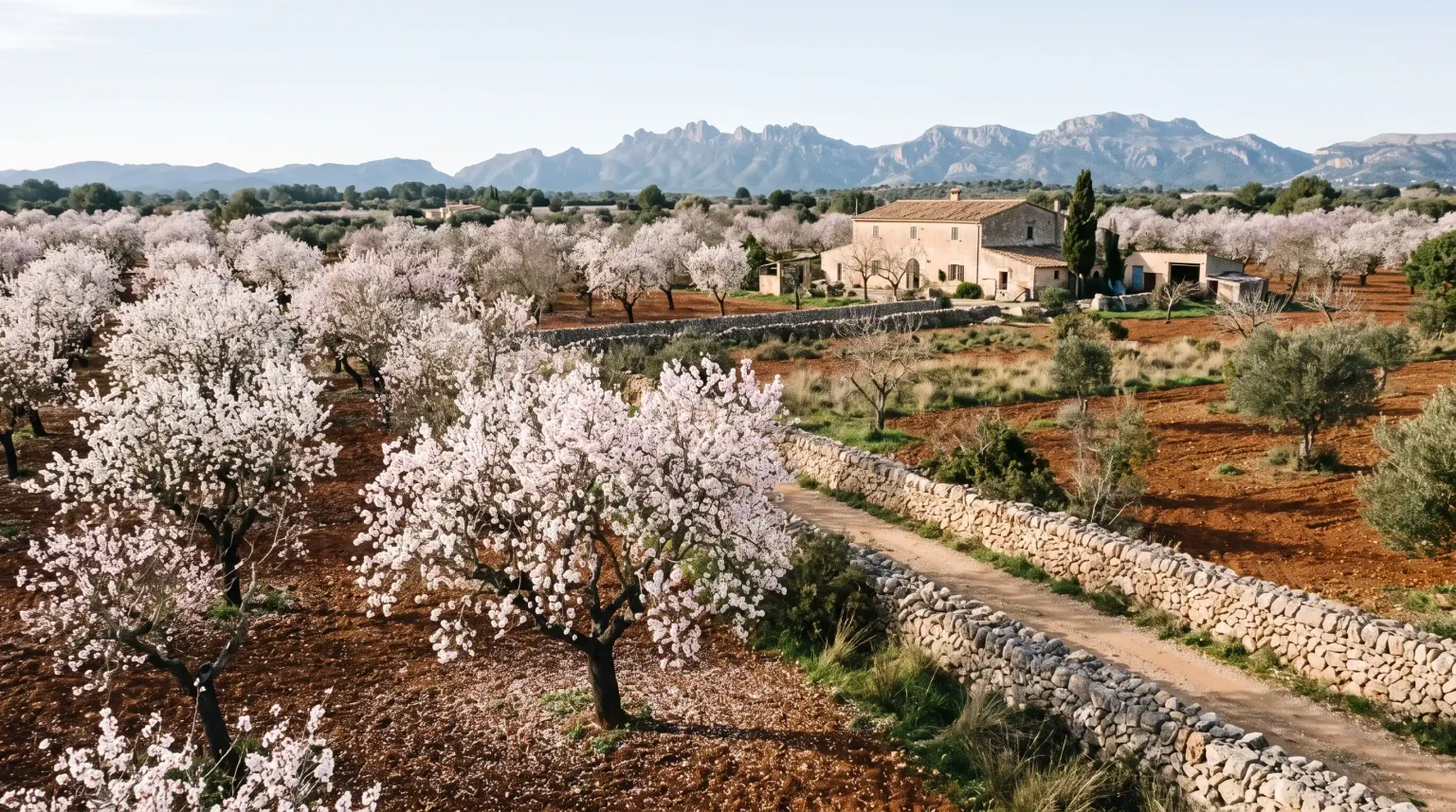
From late January and through February, almond blossom paints the inland fields white and pink. Exact timing depends on the year and the area, so don’t plan a trip around it alone, but if you catch it, it’s one of the loveliest sights of the year on the island. The roads between Santa Maria, Consell and Binissalem are a good place to start.
If you’re looking for couple plans in Mallorca outside the high season, winter offers something summer can’t: the island almost to yourselves. And if your free day falls on a Sunday, you’ll find ideas in what to do on a Sunday in Mallorca.
Winter festivals in Mallorca: from Three Kings to Sant Sebastià
Before January, December has a calendar of its own, with Palma’s Christmas markets, the Song of the Sibyl on Christmas Eve and the Festa de l’Estendard on the 31st: our guide to Christmas in Mallorca covers it all.
January in Mallorca is busier than it looks from the outside. The Three Kings parade on 5 January fills the streets of Palma and almost every village, with a turnout to rival any other date in the calendar.
Sant Antoni (16–17 January) is the island’s most deeply rooted festival. On the night of the 16th, bonfires known as foguerons are lit across the inland towns, with sa Pobla, Manacor, Muro and Artà among the best known. There’s music, dimonis (devil figures) dancing around the flames and an energy that isn’t put on for visitors. On the 17th come the beneïdes, the blessing of the animals, in many villages and in Palma too.
Sant Sebastià, Palma’s patron saint, is celebrated on 20 January. The revetla on the night before is the city’s big night out: concerts in Plaça Major and other stages around the old town, and bonfires with barbecues in the streets. Check Palma City Council’s programme for details, as it changes every year.
Winter food: the centre of the day on the island
In summer, eating is a pause between activities. In winter, food becomes the backbone of the day. Not for lack of things to do, but because the season invites it: produce is at its best, the pace is slower and sitting down to a long lunch stops being a luxury and becomes the norm.
The matances, the traditional pig-slaughter season, run from November to January. Freshly made sobrassada, llom amb col, botifarró and the pork dishes typical of this time of year fill inland menus like in no other season. Sopes mallorquines, frit and pulse stews are another register altogether: slow, local, cold-weather cooking. Sóller oranges are at their best between December and February, and the winter catch reaches kitchens in fine condition.
For more on what’s worth trying on the island at any time of year, our guide to what to eat in Mallorca goes into more detail.
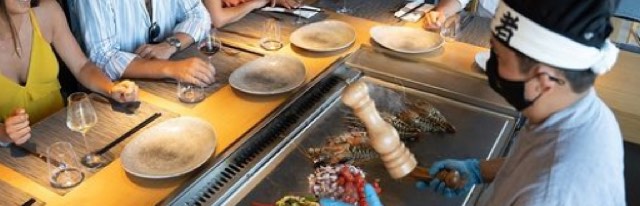
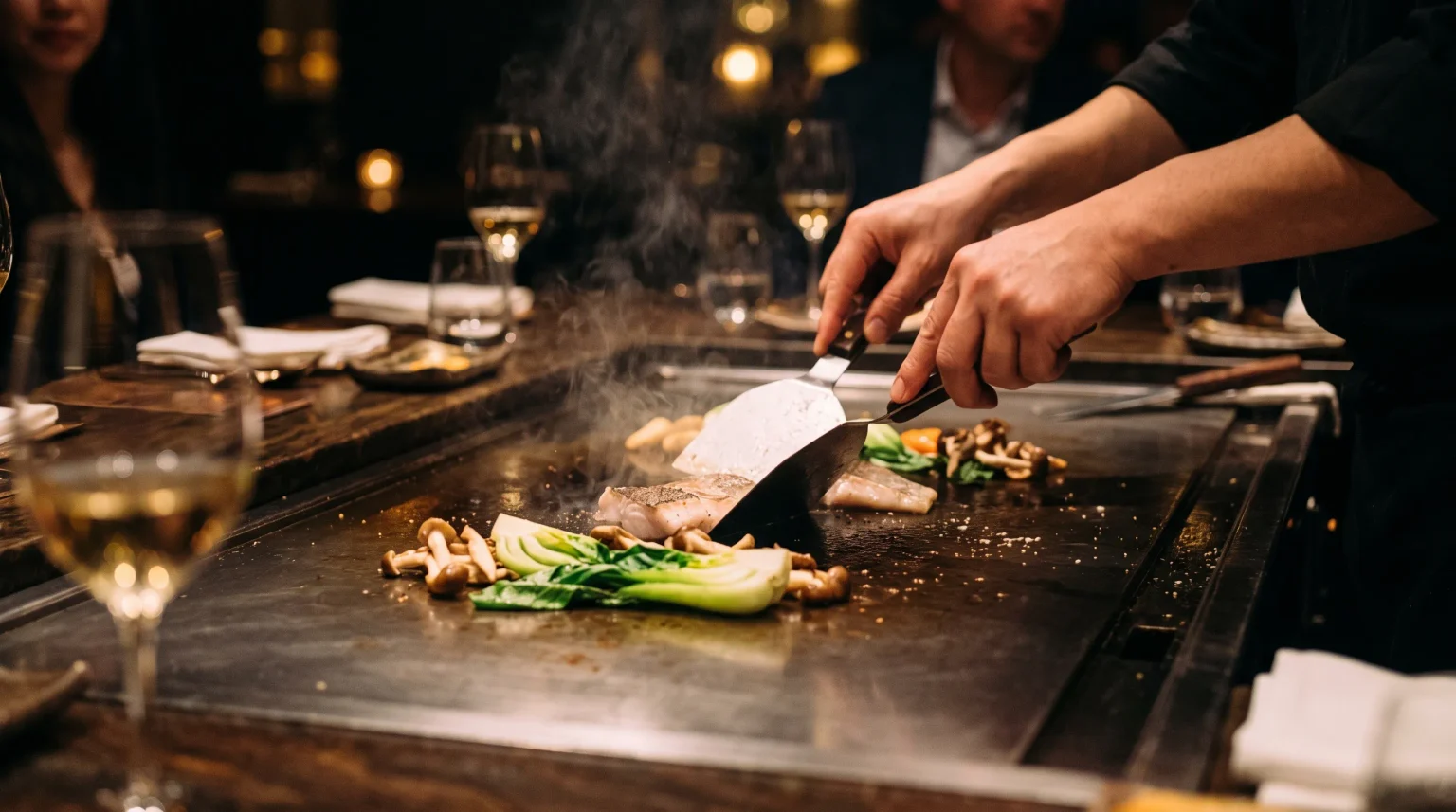
And when the evening calls for something different, teppanyaki in Palma is one of those dinners that suits winter particularly well: the sizzle of the grill, the warmth rising from the hotplate and the ritual of watching your food cooked in front of you while it cools down outside. If you’re not quite sure what it involves, we explain it from scratch in what is teppanyaki.
Sunset at aperitivo time: the detail that changes the plan
In December the sun sets over the Bay of Palma at around 5.25 pm; in January, between 5.30 and 6 pm; in February, just after 6 pm. It’s an astronomical fact rather than a sales pitch, but it has a practical consequence that changes the shape of the day: sunset and aperitivo hour coincide.
If you’re at one of the rooftop bars in Palma overlooking the bay at that time, you can watch the sky turn from blue to orange with a drink in hand and stay on for dinner without night catching you halfway through a walk. In summer, the sun doesn’t set until after nine. In winter, the evening is more compact and, planned well, it all fits together better.
At Katagi Blau, Asian-Mediterranean fusion cooking and the teppanyaki grill take on a different meaning in the colder months: warming up with a signature cocktail as the bay goes dark and staying on for an unhurried dinner is a combination only winter offers. You can browse our menu before booking a table.
In our guide to sunset in Mallorca we explain at more leisure why that band of evening light is one of the best moments of the day on the island.
How to plan your day
A winter day in Mallorca has its own logic, different from summer. The morning is the active part: the light is good from shortly after eight, the air is fresh and whether you’re exploring Palma on foot, walking in the Tramuntana or visiting Valldemossa, the hours before midday go a long way.
Lunch, taken slowly, marks the middle of the day. Without the heat or the rush to make the most of the beach, sitting down to eat well, in a city-centre restaurant, an inland celler or anywhere with something real on the plate, stops being a chore and becomes the plan itself.
The afternoon is short, so plan with that in mind. An hour or two to stroll, visit, shop or simply look out over the bay. Around five, head for the sunset: a viewpoint, a terrace, a rooftop. Then the evening and dinner, without hurry.
That pattern of an active morning, a slow lunch, a short afternoon and the sunset as the hinge is what makes a winter week in Mallorca feel full without being exhausting.
For groups and winter celebrations
There’s one kind of visitor winter in Mallorca suits especially well: someone looking for a place to celebrate something that matters. A January anniversary, a February birthday that deserves more than the usual restaurant, a Christmas work dinner that doesn’t want to look like all the others.
In winter there’s more availability than in high season and the atmosphere is more intimate. Dinner facing the bay, with the grill fired up and low light on the table, suits a celebration in a way that gets lost in the noise of August.
If you’re organising corporate dinners and celebrations between December and February, our events page sets out the options and how to get in touch with our team. And if you’d rather start with what’s on the table, our menu is the first step.
Mallorca in winter isn’t a scaled-down version of Mallorca in summer. It’s another island, with a different rhythm, different produce and a different light. Come knowing that, plan your day honestly around an active morning, a slow lunch and a well-timed sunset, and chances are you’ll be back.