
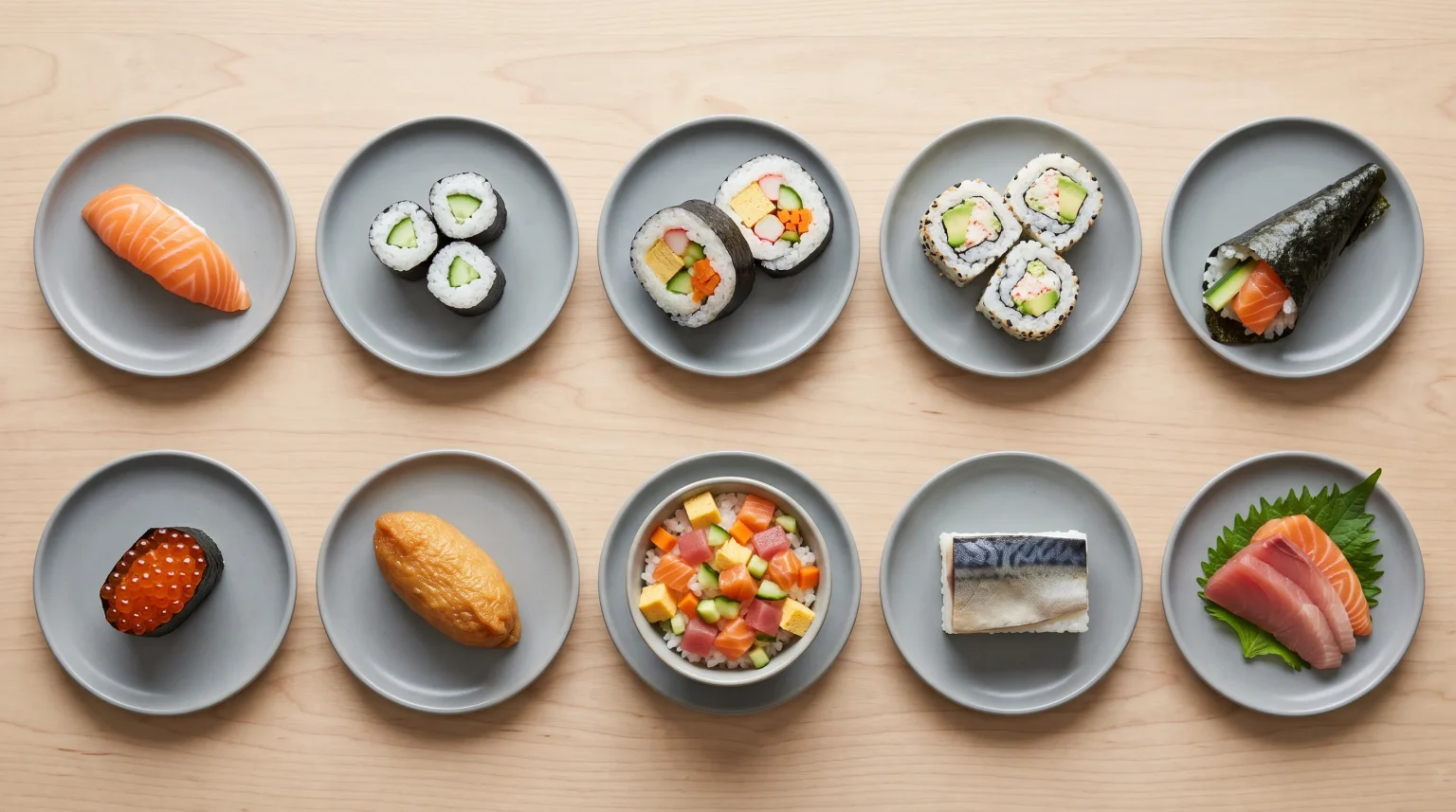
There are many types of sushi, and the main ones are nigiri, maki (with its variations hosomaki, futomaki and uramaki), temaki, gunkan, chirashi and inari. Sashimi usually appears alongside them on the menu, although strictly speaking it isn’t part of the family. What defines sushi isn’t the fish, it’s the rice.
That’s the first thing worth knowing before you open any menu, because it changes how you read what’s in front of you. Good sushi starts with the rice, and if the rice fails, no fish can make up for it. Let’s take it step by step.
What sushi is: the rice, not the fish
The common element in every type of sushi is shari: short-grain rice seasoned with rice vinegar, sugar and salt. Without that rice there’s no sushi, whatever goes on top or inside.
That clears up one of the most widespread misunderstandings: sushi doesn’t mean raw fish. There’s sushi made with vegetables, with omelette (tamago, a classic at any Japanese counter), with cooked seafood, or with cured or flamed fish. Raw fish can be an ingredient of sushi, but it doesn’t define it.
Part of the confusion comes from how sushi is presented outside Japan, where the visual side (the colour of the salmon, the roe, the shine of the sauce) ends up overshadowing what’s underneath. Once you know what to look for, the rice comes to the fore.
The origins of sushi: from fermented fish to Edo nigiri
Sushi didn’t start out the way we know it today. Narezushi, its oldest form, was fish fermented for months in rice with salt. The rice was there for the fermentation and was thrown away afterwards; nobody ate it.
Over time the process got shorter, the rice began to be eaten with the fish and vinegar replaced the long fermentation. In the early 19th century came the format we now recognise as nigiri, usually credited to Hanaya Yohei in Edo, today’s Tokyo: simple, fresh sushi meant to be eaten standing up at the street stalls of the day. A practical answer for a city in a hurry.
That context explains why nigiri is the way it is: a small piece, made by hand, meant to be eaten on the spot. Every decision in the technique has a reason.
The main types of sushi, one by one
Nigiri
Nigiri is an oblong portion of hand-pressed rice (the name comes from the word for “to squeeze”) topped with a slice of fish, seafood or omelette. It’s the format closest to the Edo original and, for many, the most honest: no seaweed wrapping, no filling to complicate things, just rice and produce. That’s also what people mean when they look up the nigiri meaning.
You’ll recognise it by its oval shape and the slice placed directly on the rice, sometimes with a touch of wasabi in between. On the Katagi Blau menu you’ll find, for example, cured sea bass nigiri with olive oil pearls and kizami wasabi, or yellowtail with tosa shoyu and lime zest. The balance between rice, fish and the barest seasoning is where umami shows itself most directly.
Maki
Maki means “roll”: rice and one or more ingredients wrapped in a sheet of nori (pressed, toasted seaweed) and cut into cylindrical pieces. There are two formats within maki, each with its own logic.
Hosomaki is the thin roll with a single ingredient, such as cucumber, tuna or salmon; restraint is its strength. Futomaki is the thick roll, with several ingredients that complement each other in every bite. You can tell them apart by size: hosomaki is a single bite, while futomaki, being thicker, often takes two.
Uramaki
Uramaki is the “inside-out” roll: the rice is on the outside and the seaweed on the inside, wrapped around the filling. It became popular outside Japan, above all in the United States (accounts of its origin don’t agree on an inventor or a date), and it was the format that won over people who found seaweed on the outside unfamiliar. The California roll is the best-known example.
The difference from maki isn’t just looks. With the rice on the outside, uramaki can take toppings (sesame, roe, a layer of avocado or fish) that add texture and flavour without touching the inside. At Katagi, the signature rolls follow this logic: an uramaki structure on which the produce and technique are built.
Temaki
Temaki is a cone of nori filled with rice and ingredients, uncut, held in the hand and eaten whole. Its informality is part of its identity: it never meets the knife and isn’t served in pieces. It’s a counter format, quick and meant for the moment.
Gunkan
Gunkan means “battleship” in Japanese, and the shape explains why: a base of rice wrapped by an upright strip of nori, creating a container open at the top. It’s designed for ingredients that won’t sit on rice by themselves, such as sea urchin, salmon roe or a tartare. The seaweed acts as a wall, not a wrapping.
Chirashi
Chirashi dispenses with shape altogether: a bowl of rice with the ingredients scattered on top in no fixed order. The name means “scattered”. It’s one of the most everyday formats in Japan, closer to a full meal than a tasting piece.
Inari
Inari is rice inside a pouch of fried tofu marinated in soy and mirin. It contains no fish. The contrast between the rice and the sweet, spongy pouch makes it one of the friendliest types for anyone not after raw fish, and one of the most underrated outside Japan.
Oshizushi
Oshizushi is pressed sushi made in a mould, typical of the Osaka region. The rice and topping are packed into a wooden box and then cut into rectangular blocks. It’s generally thought to predate nigiri and has a denser texture than any other format.
Nigiri vs sashimi: why sashimi isn’t sushi (even though it’s always next to it)
Sashimi is simply the cut of fish or seafood, with no rice and no seaweed. That’s why, strictly speaking, it isn’t part of the sushi family: it lacks shari, the element that defines every type above.
Nigiri vs sashimi is the most common mix-up. Nigiri has rice; sashimi doesn’t. Sashimi is the fish alone, cut with precision, sometimes resting on a little grated daikon. When people talk about “sushi and sashimi” as if they were the same thing, sashimi is being used as shorthand for “raw fish”, not as a technical category.
The Katagi menu includes bluefin tuna and cured sea bass sashimi, among others. These are cuts that show the quality of the produce and the knife work before anything else comes into play. That’s why sashimi is often called the toughest test of a sushi counter: there’s nothing to hide a poor cut.
Aburi or flamed nigiri: what changes when the torch meets the fish
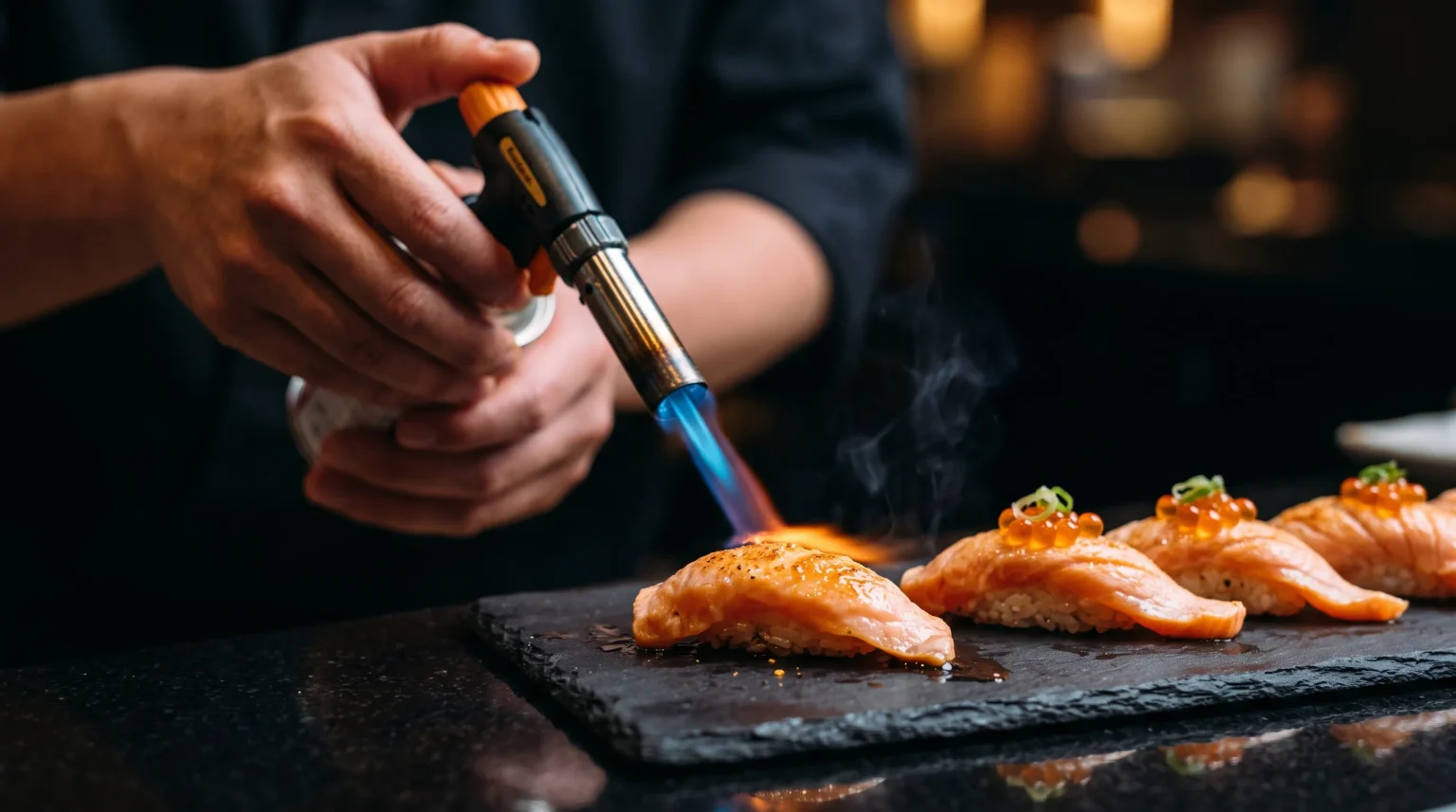
Aburi isn’t a type of sushi but a technique: briefly flaming the surface of the fish with a blowtorch to melt the outer fat and create a lightly seared finish without cooking the inside. You can see it on the plate (a faintly golden surface) and smell it before you taste it: the heat releases the fat and the aroma becomes rounder, with a smoky note raw fish doesn’t have.
Done well, the torch adds a dimension without erasing the others. On the Katagi menu, the aburi nigiri of salmon belly with ikura roe, scallop with XO hollandaise, yellowtail with olive cream and guindilla peppers, or A5 wagyu are examples where the flaming is part of the flavour rather than a visual trick.
When aburi is used to disguise mediocre produce, it loses its point. When it’s applied to produce with fat and personality, it adds without taking anything away.
How to recognise good sushi before you taste it
The type on the menu matters less than how it’s made. There are four things you can check before the first bite.
The rice. It should reach the table close to body temperature, not fridge-cold. The vinegar should be integrated rather than a loose sharpness. And the pieces should hold together without being packed tight: if the rice falls apart when you pick it up, or is so compact it won’t give, something went wrong in the cooking or shaping.
The cut. A clean cut is visible: the blade goes through the fish without tearing it and leaves a smooth surface. A ragged cut means a dull knife or poor technique, and no sauce can hide that.
The proportion. In nigiri, the slice of fish and the rice base have to be in balance. If the rice dominates, the fish can’t express itself; if the fish is so thick the rice disappears, the piece loses its structure. Proportion isn’t aesthetics, it’s flavour.
The sauces. A sauce should lift, not smother. If a roll needs three sauces to taste of something, the produce probably can’t stand on its own. At a counter with judgement, every sauce is there for a reason.
Katagi Blau works with this logic in its Asian-Mediterranean fusion cooking: Japanese technique applied to Mediterranean flavours, such as cured sea bass, Mallorcan olive oil, olives and guindilla peppers, without fusion becoming an excuse to stray from the essentials. The difference between fusion with judgement and fusion for show is that the technique isn’t up for negotiation. It’s the same argument behind nikkei cooking, where the Japanese foundation and local produce are treated with respect for both traditions. You can see how it translates to the table on our sushi menu.
Summary table: the types of sushi at a glance
| Type | What it is | Rice? | Seaweed (nori)? |
|---|---|---|---|
| Nigiri | Hand-pressed rice topped with a slice of fish or seafood | Yes | No (apart from an optional strip to hold it) |
| Hosomaki | Thin roll with a single ingredient, seaweed on the outside | Yes | Yes, outside |
| Futomaki | Thick roll with several ingredients, seaweed on the outside | Yes | Yes, outside |
| Uramaki | Roll with rice on the outside and seaweed inside | Yes | Yes, inside |
| Temaki | Seaweed cone filled with rice and ingredients, eaten by hand | Yes | Yes |
| Gunkan | Rice base wrapped by a strip of seaweed, filling on top | Yes | Yes |
| Chirashi | Bowl of rice with ingredients scattered on top | Yes | No (sometimes in strips on top) |
| Inari | Rice inside a pouch of marinated fried tofu | Yes | No |
| Oshizushi | Rice and toppings pressed in a mould and cut into blocks | Yes | Usually not |
| Sashimi | A cut of fish or seafood without rice | No | No |
Types of sushi: frequently asked questions
What type of sushi should I order first?
Nigiri is the most direct starting point: few ingredients, nothing to distract and the technique in full view. If you’d rather start with something more familiar, an uramaki with simple ingredients (salmon, avocado, cucumber) is an easy way in. What matters isn’t getting the type right but paying attention to the rice: if it arrives slightly warm with just the right touch of vinegar, the rest usually follows.
What’s the difference between maki and uramaki?
The position of the seaweed and the rice. In maki the seaweed is on the outside and the rice is inside, around the filling. In uramaki it’s the other way round: rice on the outside, seaweed inside. That’s why uramaki can be covered with sesame, roe or slices of avocado, which changes both the texture and the look of the roll.
Should you eat sushi with chopsticks or with your hands?
Both are fine. In Japan nigiri is often eaten by hand and dipped fish-side down, not rice-side: that way you control the soy sauce and the rice doesn’t fall apart. These are common customs, not rules, and no serious sushi counter will correct you for using chopsticks.
Does sushi always contain raw fish?
No. Inari has no fish, tamago is omelette and there are rolls made with vegetables, chicken or cooked ingredients. Aburi, too, applies heat to the fish before serving. Raw fish is one possible ingredient of sushi, not a condition for it. On our menu you’ll find, for example, vegetable rolls and free-range chicken tempura rolls.
Japanese technique and Mediterranean produce: the Katagi approach
Katagi Blau is an Asian-Mediterranean fusion restaurant in Playa de Palma. Its sushi menu starts from Japanese technique (the rice, the cut, the balance) and takes it to Mediterranean flavours such as Mallorcan olive oil, olives and guindilla peppers. It isn’t purely Japanese, nor fusion without a foundation: it’s cooking that knows where each decision comes from.
The island’s produce has its own guide in what to eat in Mallorca. And the house’s Japanese cooking has another side on the hotplate: teppanyaki, with its own logic and its own place on the menu. If lunchtime is more your thing, the Sunday brunch includes sushi too; we explain how it works in what is brunch.
The question in the title of this article, how to order sushi with confidence, has a practical answer: look at the rice, check the cut, read the sauces. If all three make sense, the rest will too. To see how all this applies to our sushi in Palma, the menu speaks for itself.